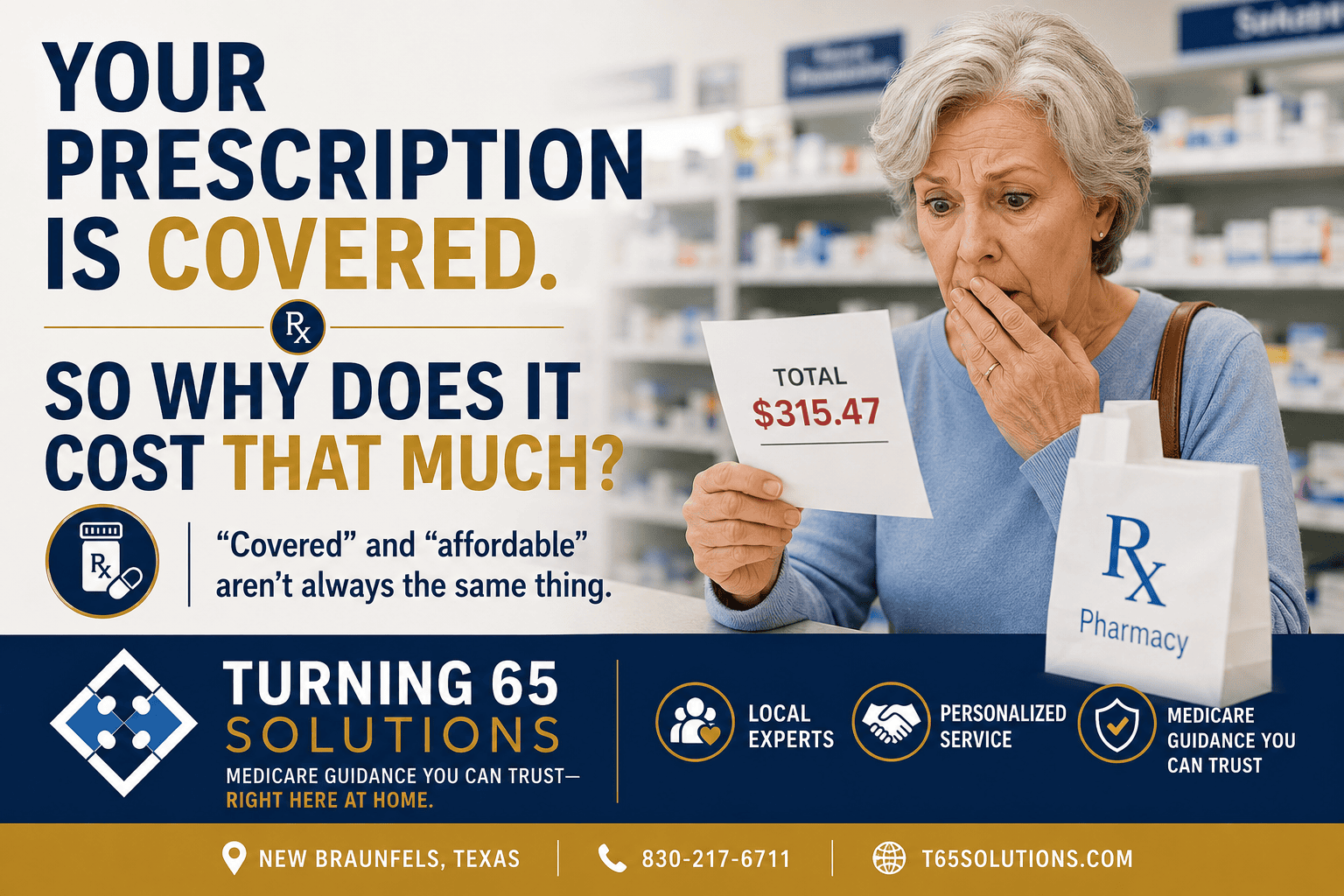
You get to the pharmacy, hand over your Medicare prescription drug plan card, and wait for your prescription.
Then the pharmacist tells you what you owe.
$80. $150. Maybe $300 or more.
And your first reaction is probably:
“Wait a minute. I thought this drug was covered.”
It may be.
One of the most confusing things about Medicare prescription drug coverage is that “covered” does not necessarily mean “cheap.”
A prescription can be on your Medicare drug plan’s formulary and still leave you with a surprisingly large bill at the pharmacy.
Here’s why.
Why Is My Prescription So Expensive If Medicare Covers It?
The short answer is that Medicare prescription drug plans don’t simply classify medications as either “covered” or “not covered.”
Your Medicare prescription drug costs can depend on several factors, including:
- Your plan’s deductible
- The drug’s formulary tier
- Whether the plan charges a copay or coinsurance
- The pharmacy you use
- Whether the pharmacy is preferred by your plan
- The negotiated price of the medication
- Where you are in your plan’s annual benefit
- Whether the prescription requires prior authorization, step therapy, or another coverage requirement
That means two Medicare beneficiaries taking the exact same medication could potentially pay very different amounts.
It also means that choosing a Medicare drug plan based primarily on the monthly premium can be a costly mistake.
1. You May Still Be Paying Your Part D Deductible
For 2026, the standard Medicare Part D deductible can be as high as $615.
Some plans have a lower deductible, and some may waive the deductible for certain tiers of medications.
But if your medication is subject to the deductible, you may be responsible for much of the negotiated cost of the prescription until that deductible has been satisfied.
That’s why someone can pick up a prescription early in the year and suddenly discover that a medication they expected to cost $20 or $30 costs several hundred dollars instead.
The medication may still be covered.
The deductible simply hasn’t been met yet.
2. Your Drug’s Formulary Tier Matters
Medicare drug plans generally organize covered medications into different formulary tiers.
A typical formulary might include lower-cost generic drugs on lower tiers and more expensive brand-name or specialty medications on higher tiers.
The higher the tier, the greater your potential cost-sharing may be.
And here’s an important point:
The same medication doesn’t necessarily have to be placed on the same tier by every Medicare drug plan.
A drug that receives favorable treatment under one plan may be considerably more expensive under another.
That’s one reason we believe Medicare drug coverage should be reviewed based on the medications a person actually takes—not simply the name or premium of the plan.
3. Copay and Coinsurance Are Not the Same Thing
This distinction can make a significant difference in your Medicare prescription drug costs.
A copay is generally a fixed dollar amount.
For example:
You pay $15 for the prescription.
Coinsurance works differently.
Instead of paying a fixed amount, you pay a percentage of the drug’s negotiated cost.
For example, if your share is 25% and the negotiated cost of a medication is $800, your portion could be $200.
That’s a very different experience from paying a $15 copay.
This is one reason people sometimes experience sticker shock with expensive brand-name and specialty medications even though those drugs are technically covered by their plan.
4. The Pharmacy You Use Can Change What You Pay
This surprises a lot of Medicare beneficiaries.
Your Medicare prescription drug plan may have a network of pharmacies, and some plans designate certain locations as preferred pharmacies.
Depending on the plan and medication, filling a prescription at a preferred pharmacy may cost less than filling the exact same prescription somewhere else.
So before assuming your drug plan is the problem, it’s worth checking the pharmacy too.
Sometimes changing pharmacies can make a meaningful difference without changing Medicare plans at all.
5. Your Medicare Drug Plan May Have Changed
Medicare prescription drug plans can change from year to year.
That can include changes to:
- Premiums
- Deductibles
- Copays
- Coinsurance
- Formularies
- Drug tiers
- Pharmacy networks
- Prior authorization requirements
And your prescriptions can change too.
A Medicare drug plan that worked beautifully for you last year isn’t automatically the best choice this year.
That’s why we encourage our clients to review their prescription drug coverage periodically, particularly during Medicare’s Annual Enrollment Period.
Is There a Maximum Amount I Can Pay for Medicare Part D Drugs in 2026?
Yes.
For 2026, out-of-pocket spending for covered Medicare Part D prescription drugs is capped at $2,100 for the year.
Once you reach the applicable out-of-pocket threshold, you pay $0 for covered Part D drugs for the remainder of the calendar year.
That’s an important protection for people who take expensive medications.
But there’s an important distinction:
The $2,100 limit does not mean every prescription will be inexpensive throughout the year.
Someone taking an expensive medication could still face significant costs earlier in the year before reaching that limit.
What Is the Medicare Prescription Payment Plan?
Medicare also offers the Medicare Prescription Payment Plan.
This option allows people with Medicare drug coverage to spread their out-of-pocket Part D prescription costs across monthly payments instead of paying the entire amount at the pharmacy.
That can help someone who encounters a large prescription expense early in the year manage their cash flow.
But there’s an important misconception to clear up:
The Medicare Prescription Payment Plan does not reduce the cost of your prescriptions.
It changes when you pay, not how much you ultimately owe.
For some beneficiaries that’s extremely useful. For others, it may provide little benefit.
What Should I Do If My Medicare Prescription Suddenly Costs Too Much?
Before simply paying the bill—or deciding that Medicare doesn’t cover the medication—find out why the price is high.
Start by checking:
- Is the medication on your plan’s formulary?
- What tier is it on?
- Does the deductible apply?
- Are you paying a copay or coinsurance?
- Is your pharmacy preferred by your plan?
- Is there a lower-cost formulary alternative you can discuss with your doctor?
- Does the medication require prior authorization or step therapy?
- Could you qualify for Medicare’s Extra Help program?
- Would another Medicare drug plan better fit your complete prescription list when you’re eligible to change plans?
The answer isn’t always “switch plans.”
Sometimes the solution is much simpler.
Need Help Understanding a High Prescription Cost in New Braunfels?
If you live in New Braunfels or the surrounding Texas Hill Country and recently got an unpleasant surprise at the pharmacy, this is exactly the kind of Medicare problem we help people work through.
At Turning 65 Solutions, we don’t believe a Medicare drug plan should be evaluated by premium alone.
We look at the bigger picture:
Your medications. Your pharmacy. Your doctors. Your coverage. Your situation.
We’re a local Medicare agency serving New Braunfels and the surrounding area, and our team can help you understand what your Medicare coverage is actually doing—not just what the plan brochure says.
If you recently received an unexpectedly high pharmacy bill, bring us your medication list and your Medicare plan information.
We’ll help you figure out what’s happening.
Because when it comes to Medicare prescription coverage:
“Covered” and “affordable” aren’t always the same thing.
Frequently Asked Questions About Medicare Prescription Drug Costs
If Medicare Covers My Prescription, Why Do I Still Have to Pay?
“Covered” means the medication is covered under your plan’s rules. It does not necessarily mean the plan pays the entire cost. You may still have a deductible, copayment, or coinsurance depending on your plan and medication.
What Is the Medicare Part D Deductible in 2026?
The standard Medicare Part D deductible can be as high as $615 in 2026. Individual plans may have a lower deductible or may not apply the deductible to certain medications.
What Is the Medicare Part D Out-of-Pocket Maximum for 2026?
For 2026, out-of-pocket spending for covered Part D prescription drugs is capped at $2,100. After reaching the applicable threshold, beneficiaries pay no additional cost-sharing for covered Part D drugs for the remainder of the calendar year.
Can Changing Pharmacies Lower My Prescription Costs?
Potentially. Medicare drug plans may have preferred pharmacies where certain prescriptions cost less. Check your plan’s pharmacy network before moving prescriptions.
Does the Medicare Prescription Payment Plan Make Prescriptions Cheaper?
No. The Medicare Prescription Payment Plan can spread your out-of-pocket Part D expenses across monthly payments, but it does not reduce the total cost of your prescriptions.
Should I Choose the Medicare Part D Plan With the Lowest Premium?
Not necessarily. A low-premium plan can ultimately cost more if it has unfavorable coverage for the medications you take.
Comparing your estimated total annual costs—including premiums and prescription costs—is generally more useful than comparing premiums alone.
Turning 65 Solutions is an independent insurance agency. We do not offer every plan available in your area. Currently we represent multiple organizations which offer products in your area. Please contact Medicare.gov, 1-800-MEDICARE, or your local State Health Insurance Assistance Program (SHIP) to get information on all of your options.